

Posted on 8th July 2026, by Admin
By Dr. Sachender Pal Singh
Consultant Head & Neck Surgical Oncologist and Microvascular Reconstructive Surgeon
Receiving a diagnosis of laryngeal (voice box) cancer can be overwhelming. One of the first questions many patients ask is:
"If my voice box is removed, will I ever be able to speak again?"
The answer is yes—for many patients.
Although the voice will not be exactly the same as before, modern rehabilitation techniques allow many people to communicate effectively after surgery. One of the most successful methods is Tracheoesophageal Puncture (TEP) with a voice prosthesis.
Understanding this option before surgery can help reduce anxiety and prepare patients and their families for life after treatment.
A total laryngectomy is an operation in which the entire voice box (larynx) is removed, usually to treat advanced laryngeal cancer or selected cancers of the hypopharynx.
After surgery:
Fortunately, loss of the natural voice does not mean the end of communication.
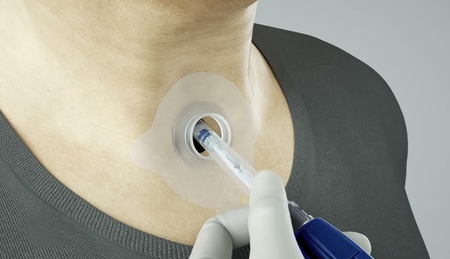
A Tracheoesophageal Puncture (TEP) is a small surgically created passage between the windpipe (trachea) and the food pipe (oesophagus).
A voice prosthesis (a small one-way valve) is placed in this opening.
When the patient covers the tracheostoma with a finger or uses a hands-free speaking valve, air is redirected through the prosthesis into the oesophagus. The tissues vibrate and create sound, allowing speech.
Although the voice sounds different from the original voice, many patients develop speech that is clear, understandable, and suitable for everyday conversations.
TEP may be considered for many patients undergoing:
The decision is individualised after evaluation by the treating surgical team.
TEP can be performed in two ways:
The puncture and voice prosthesis are placed during the same operation as the laryngectomy.
Advantages
The puncture is performed weeks or months after recovery from surgery.
This option may be preferred depending on healing, previous treatments, or patient factors.
Both approaches can provide excellent voice rehabilitation when appropriately selected.
Compared with other methods of voice rehabilitation, TEP offers several benefits:
Not necessarily.
Some patients communicate successfully using:
The most suitable option depends on the patient's health, motivation, anatomy, previous treatment, and discussion with the treating team.
Like any medical device, a voice prosthesis requires regular care.
Patients are taught how to:
Most voice prostheses require periodic replacement. The interval varies between individuals.
Speech rehabilitation is not achieved by surgery alone.
Speech and language therapists play a vital role in helping patients:
Regular practice and rehabilitation significantly improve long-term outcomes.
Many people worry that life will never be normal after removal of the voice box.
In reality, with appropriate treatment, rehabilitation, and support, many patients return to:
The journey requires patience, but modern rehabilitation has transformed the quality of life for many laryngectomy survivors.
Yes. Many patients can regain understandable speech using a TEP voice prosthesis, although the voice will sound different from their original voice.
Each method has advantages and limitations. The best option depends on individual circumstances and should be discussed with the treating team.
The lifespan varies between individuals. Most prostheses require periodic replacement as part of routine care.
Many patients resume oral feeding after appropriate healing and assessment. Dietary advice is individualised.
Yes. Speech therapy is an essential part of successful voice rehabilitation and helps patients achieve the best possible communication.
A diagnosis of voice box cancer can be life-changing, but losing the natural voice does not mean losing the ability to communicate.
Modern techniques such as Tracheoesophageal Puncture (TEP) have transformed the lives of many patients by restoring functional speech and improving quality of life after total laryngectomy.
If you or a loved one has been advised to undergo surgery for laryngeal cancer, discuss the available voice rehabilitation options with your treating team. Understanding these options before surgery can make the recovery journey less daunting and help patients return to active, fulfilling lives.
Dr. Sachender Pal Singh is a Consultant Head & Neck Surgical Oncologist and Microvascular Reconstructive Surgeon at Ranchi Cancer Hospital & Research Centre (RCHRC), a unit of Tata Cancer Care Foundation. His clinical interests include oral cancer, laryngeal cancer, thyroid cancer, salivary gland tumours, skull base surgery, and microvascular reconstruction. He is committed to improving cancer awareness through evidence-based patient education and helping individuals make informed decisions about their treatment.
This article is intended for patient education only and should not replace consultation with a qualified healthcare professional. Every patient's condition is unique, and treatment decisions should always be made after discussion with the treating medical team.